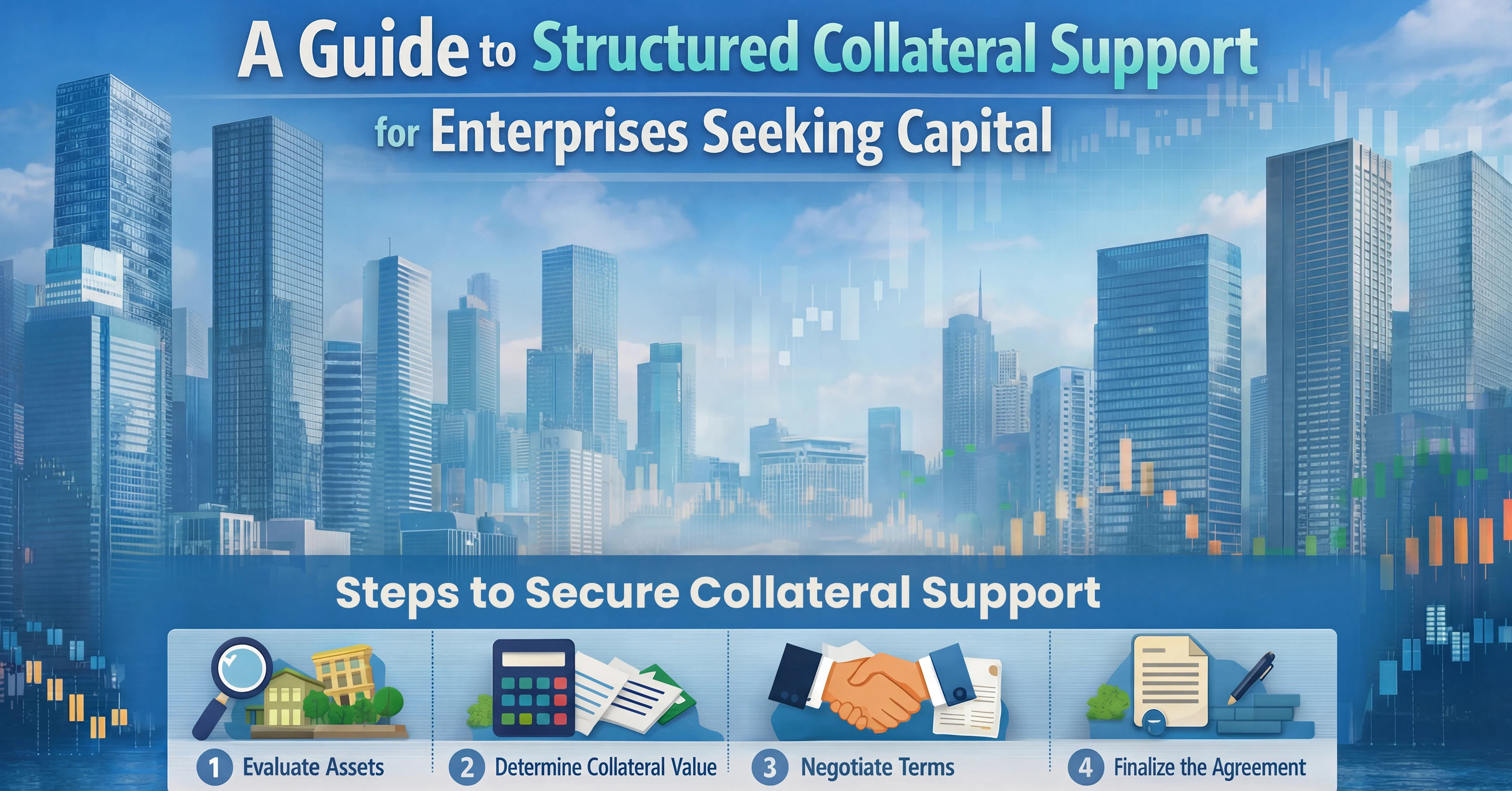
This is the biggest hurdle for businesses in India today.
MSMEs (Micro, Small and Medium Enterprises) and mid-sized companies have a huge demand for capital. We are talking about large amounts of money, often between ₹10 crore to ₹500 crore or even more. However, having a great business plan isn't enough for banks. Banks need safety. They need collateral (security) to ensure that if things go wrong, they can recover their money.
Why do businesses lack land?
Most modern businesses are "asset-light." This means they lease their offices or factories rather than buying them. A software company, a logistics firm, or a trading house might generate crores in profit, but they might not own a single piece of land. Without land or property to offer as security, banks often say "no" or offer a very small loan amount.
The Solution:
This is where a new, powerful solution comes in. It is called business collateral support. This is a system where a business that needs money connects with a landowner who has idle property. The landowner doesn't sell the land; they simply let the business use the land’s papers to secure the loan.
This bridge between a business needing money and a landowner holding assets is changing the face of finance. It unlocks capital for the business and generates income for the landowner.
What Are Collateral Partnerships?
Let’s break this down into the simplest terms possible.
A collateral partnership is like having a financial co-pilot. In the traditional world, if you wanted a loan, you had to own the house or land you were pledging. But in this new model, two parties come together to help each other.
The Two Parties:
1. The Borrower (The Business): This is the company that needs the loan to grow but doesn't have property to pledge.
2. The Provider (The Landowner): This is an individual or entity that owns high-value real estate (land, hotels, commercial buildings) but doesn't necessarily need a loan themselves. They act as the landowner collateral provider.
How it Works Simply:
Think of it like renting a tuxedo for a wedding. You don't need to buy the tuxedo to look good for the event; you just need to borrow it. Similarly, the business "borrows" the strength of the landowner’s property to show the bank they are secure.
The landowner agrees to let their property be used as security for the business's loan. In return, the business pays the landowner a fee or a percentage of the loan amount. It is a win-win situation. The business gets the money they couldn't get on their own and the landowner earns money on a property that was just sitting there doing nothing.
This is very different from traditional collateral. In traditional lending, you are limited by what you own. In collateral partnerships, you are only limited by the quality of the partner you can find.
The Concept of Verified Landowners: Why It Matters
Now, you might be thinking, "Can I just use anyone's land?" The answer is a strict no. The most critical part of this entire process is "Verification."
Banking in India (and globally) is very strict. Banks hate risk. If a business brings a landowner collateral provider to the bank, the bank will check every single piece of paper related to that land.
Why Verification is King:
1. Title Clarity: The land must have a "clean title." This means there should be no disputes, no family fights over who owns it and no hidden legal cases.
2. Ownership Proof: The person claiming to own the land must be the actual legal owner.
3. Value Confirmation: The land must actually be worth what the owner says it is.
The Risk of Unverified Landowners:
If a business tries to partner with an unverified landowner, it can be a disaster. Imagine spending months negotiating a deal, only to find out at the last minute that the land has a legal stay order on it. The loan gets rejected, the business loses time and its reputation with the bank is damaged.
This is why business collateral support relies entirely on Verified Landowners. These are individuals whose properties have already been checked, vetted and cleared by legal experts. When a business partners with a verified landowner, the bank feels safe. They know the asset is real and the paperwork is solid. This protects the lender (the bank) and the borrower (the business) from fraud and delays.
Why Many Businesses Require Third-Party Collateral Support
Let's dig deeper into why a successful business would need help from outside.
It seems odd, right? If a business is making a profit, why don't they just buy land? The answer is "Cash Flow."
1. Cash should be used for growth, not locking it in the soil.
If a company has ₹50 crore, they would rather spend that money on raw materials, marketing and hiring staff, such things that generate more profit immediately. Buying land locks that money away for years. Therefore, they need business collateral support to get a loan without spending their own cash on real estate.
2. The Need for "Ticket Size."
We are not talking about small personal loans here. Businesses often need massive amounts such as ₹100 crore, ₹200 crore, or even ₹500 crore for large projects like building a highway, setting up a solar power plant, or constructing a resort. Very few businesses have spare property worth that much sitting on their balance sheet.
3. Lender Demands.
Banks and Non-Banking Financial Companies (NBFCs) are becoming stricter. For every ₹100 they lend, they might want security worth ₹125 or ₹150. Even if a business owns some land, it might not be enough to cover the huge loan they need.
This gap lies between what the bank wants and what the business has; it is filled by collateral partnerships. By bringing in a third party (the landowner), the business suddenly meets the bank's requirements perfectly.
How Collateral Partnerships Work: Step-by-Step Process
If you are a business owner or a landowner, you are probably wondering, "Okay, how do we actually do this?" It is a structured process. It is not done over a handshake; it involves professionals and platforms.
Here is the journey of a landowner collateral provider and a business coming together:
Step 1: The Requirement
The business analyzes its needs. They realize, "We need ₹50 crore for expansion, but we only have security worth ₹10 crore." They identify the need for business collateral support.
Step 2: Finding the Match
The business approaches a specialized platform (more on this later) to find a verified landowner. They cannot just put an ad in the paper. They need a trusted partner.
Step 3: Verification and Valuation
Once a potential collateral provider is identified, the experts step in. Lawyers check the property titles. Valuers (approved by the government) go to the site to decide exactly how much the land is worth.
Step 4: Structuring the Partnership
This is the most important step. The business and the landowner sign a legal agreement. This agreement decides:
- How much fee will the landowner get?
- What happens if the business delays payment?
- How long will the land be pledged?
Step 5: Offering to the Bank
Now, the business goes to the bank with the loan application and the collateral documents from the partner. The bank sees that the loan is fully secured by high-value real estate.
Step 6: Approval and Disbursement
The bank approves the loan. The money goes to the business to use for its growth. The landowner receives their agreed-upon fees or payout.
Step 7: Closure
Once the business repays the loan over the years, the bank releases the land papers. The partnership ends successfully, or they might choose to do it again for a new project!
Features of a Secure Collateral Partnership
Not all partnerships are safe. A secure partnership for business collateral support has specific features that make it work. If you are entering this market, look for these signs:
1. Clean Land Titles:
This cannot be stressed enough. The land used in collateral partnerships must be free of any legal mess. It must be "clean."
2. Clear Legal Agreements:
There is no ambiguity. The contract clearly states that the landowner is only a landowner collateral provider. They are usually not responsible for running the business. Their risk is limited to the asset they provided.
3. Transparent Financial Terms:
Both sides know exactly who gets paid what. There are no hidden charges. The landowner knows their fee and the business knows the cost of the collateral.
4. Risk Protection:
Good partnerships often include clauses to protect the landowner. For example, the business might give post-dated cheques or personal guarantees to the landowner to assure them that the loan will be repaid on time.
5. Platform-Mediated Compliance:
The best partnerships happen through platforms that handle the KYC (Know Your Customer) and AML (Anti-Money Laundering) checks. This ensures that the money is white and the intentions are pure.
Benefits for Businesses
Why should a business go through this effort? The benefits are massive.
- Access to Capital without Ownership: The biggest benefit is leverage. You can get a loan of ₹100 crore without spending ₹100 crore to buy land first. This is the magic of business collateral support.
- Higher Loan Amounts: Banks give bigger loans when the security is real estate (land/buildings). Unsecured loans are usually small. With a landowner collateral provider, the sky is the limit for the loan size
- Faster Approvals: When a bank sees a clean, verified property title as security, they process the loan much faster. They don't have to worry about the business's vague future projections as much because the physical asset is there as a safety net.
- Scalability: A business can take on multiple projects at once. If they need to build three factories, they can partner with three different landowners. They are not limited by their own personal assets.
- Flexibility: These partnerships work for all kinds of money needs. Term Loans (for building things), Project Finance (for infrastructure), or Working Capital (for daily operations).
Benefits for Verified Landowners
Now, let’s look at the other side. Why would a landowner collateral provider agree to this? Why pledge your precious land for someone else's loan?
- Monetize Without Selling: This is the biggest advantage. In India, people love their land. They never want to sell it. But land that sits idle earns zero money. By entering collateral partnerships, the landowner keeps the ownership of the land but still makes money from it.
- High Returns: The fees paid by businesses for this service are often very attractive. It is a way to earn a "rental" income on vacant land without building anything on it.
- Passive Income: The landowner doesn't have to work in the business. They provide the documents, sign the bank papers and collect their fee. It is a passive role.
- Partner with Strong Companies: Landowners get to partner with credit-worthy, profitable enterprises. They are not lending to strangers; they are enabling successful businesses.
- Legal Safety: Since these deals are structured by professionals, the landowner has legal agreements protecting their interests.
Why Platforms Like Assets to Loan Are Critical in This Ecosystem
You cannot find these partners on social media or classified ads. It is too risky. You need a middleman who understands trust and law. This is where platforms like Assets to Loan become the heart of the system.
Assets to Loan acts as the bridge. They do not just introduce people; they manage the trust.
Curated Network:
Assets to Loan has a network of verified landowners. They have already done the hard work of checking titles and valuations. When a business comes to them, they don't have to search from scratch.
End-to-End Due Diligence:
For business collateral support to work, the paperwork must be perfect. Platforms like Assets to Loan handle the documentation, the valuation reports and the legal structuring. They ensure that what the landowner is offering matches exactly what the bank needs.
Relationship with Lenders:
These platforms often have relationships with banks and financial institutions. They know which bank accepts third-party collateral and which does not. They guide the business to the right door.
In the world of collateral partnerships, trust is the currency and platforms like Assets2Loan are the mint that issues that currency.
Real Use Cases of Collateral Partnerships
To help you understand how this works in real life, let’s look at some examples of business collateral support in action.
Case Study 1: The Manufacturing Expansion
- Situation: A textile company in Gujarat had orders from international brands. They needed to build a new factory costing ₹40 crore.
- Problem: They had invested all their cash in machinery. They had no land to offer the bank.
- Solution: They found a landowner collateral provider who had a large plot of non-agricultural land in a prime area.
- Result: The landowner pledged the land. The bank gave the textile company the loan. The factory was built, profits soared and the landowner was paid a handsome fee.
Case Study 2: The Hotel Project
- Situation: A hospitality group wanted to build a luxury resort. Construction costs were high.
- Problem: Banks consider hotels "high risk" and demand 150% security.
- Solution: The group used collateral partnerships to pool together assets from two different landowners.
- Result: With strong collateral, the bank approved the project finance. The resort is now operational.
Case Study 3: The Trading Giant
- Situation: A commodity trader needed a huge Working Capital limit (OD/CC limit) of ₹100 crore to buy grain during the harvest season.
- Problem: Trading businesses have no physical assets, only stock. Banks don't value stock highly.
- Solution: The trader engaged a landowner collateral provider with a commercial building in Mumbai.
- Result: The bank provided the cash credit limit against the building. The trader made huge profits on the turnover and paid the landowner their share.
Conclusion: The Future of Collateral Partnerships in India
India’s new growth story is all about shared strength. Collateral partnerships are helping businesses grow and helping landowners earn without selling their property. With verified landowners and transparent digital platforms, funding has become faster, safer and smarter. Every piece of unused land can now support a business dream and every genuine business can find the right collateral support. Together, this creates growth for all. So, whether you are a business owner or a landowner, connect with Assets to Loan today and unlock new opportunities through secure and verified collateral partnerships.
Read More:
Why Asset Backed Collateral Is Essential for Business Expansion Across India